Monday, 29 August 2011

Mangere — Scratching the Surface

What does Ms Average Aucklander (whoever she is) know about Mangere? That it’s home to the airport and the sewage works, major chunks of regional infrastructure that she frequently uses but seldom considers. And she’s probably seen Mangere Mountain, one of those familiar volcanic bumps on Auckland’s landscape. Finally, she’s heard tell of “social problems”, though she’d be hard pressed to give details or facts.

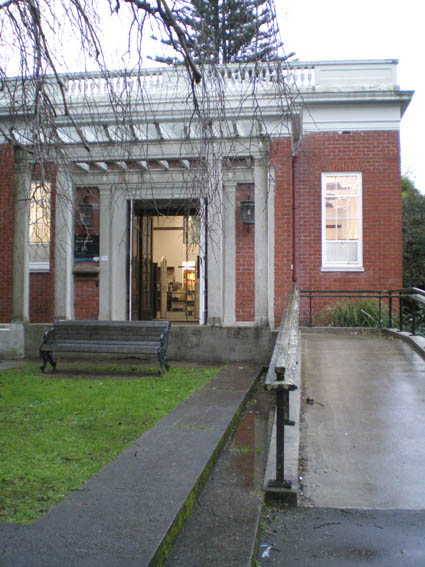
At the Mangere Town Centre library (photo:
Carol Bartlett, with subjects’ permission).

Recently I spent a day in Mangere’s company and just managed to scratch the surface, though I came away with impressions that will last — and I plan to go back. Of the three parts of South Auckland with Mangere in their name I’ve visited only the town centre, but Mangere East and Mangere Bridge have public libraries too, so they’re two (of many) reasons to return. Meanwhile, I’ve been reading about the area, and making virtual visits there on the web.

Big Men of Mangere 
Some of the streets near the airport are named after people and planes in aviation history. The one leading to the public library, Bader Drive, purportedly commemorates Englishman Douglas Bader, who lost his legs in a flying accident but went on to earn numerous honours in World War Two.*

Another local thoroughfare, Massey Road, commemorates a man who lived there. William Ferguson Massey, the prime minister whose name is also attached to the last part of Auckland I visited for this blog, began his parliamentary career in West Auckland in 1894 but represented his home ground of “Franklin” — including Mangere — from 1896 until he died in 1925. Half a century later the same street would be home to another Mangere MP and prime minister, David Lange.
 

Boxer David Tua, in A. Robson’s painting
on the town centre library wall.
Lange and ‘Farmer Bill’ Massey were both big men, physically as well as figuratively, but it’s a third local ‘big man’, boxer David Tua, whose portrait is up on the wall at the Mangere Town Centre library. Tua may be better known among the people who were at the library the day Carol and I visited, too: he’s closer to their age, he’s still standing (though his August 13 boxing opponent got the better of him), and he shares the same Samoan heritage as some.

The library is at the back of the Mangere shopping centre, which had plenty to divert us. When we drove into the carpark at about 10.30am the Saturday market was in full swing, excelling in super-fresh fruit and vegetables. We paid $3.00 for bananas, mandarins and pears that would cost twice as much even at Pak ’n Save.

Pacific Islands Central
Most vendors and shoppers at this outdoor market were Pacific Islanders, in keeping with Mangere’s majority PI population (62% at the 2006 census), and several stalls featured bundles of rolled leaves that are used in cooking across the Pacific. I thought they were banana leaves but Mr Me‘a Kai, Robert Oliver, replying to my Facebook query instantly from his current base in Shanghai, told me they were taro leaves, which have different names in the various Island languages. 

Taro leaves and more at the Mangere Market.
Samoan cuisine uses these in what Robert’s award-winning South Pacific cookbook Me‘a Kai describes as “probably the best-known green vegetable dish from the Pacific region: palusami — a custardy concoction of young taro leaves baked with rich coconut cream”. Only the young leaves can be used because taro leaves are rich in oxalate, an irritant.**

From the market we made our way into the shopping complex, which opened to fanfare in 1971. A special edition of the South Auckland Courier back then said that this, a government initiative to complement state housing, had “taken part of downtown Auckland and transported it to Mangere”. National retail chains had stores there, though The Changing Face of Mangere and a 2010 report to the Manukau City Council*** record how this has changed. Smaller shops have taken over.

Dancers, backed by a Pacific
drummer. (Photo: Carol Bartlett)
Young audience members do
some drumming of their own.
Arriving in the courtyard at the centre of the complex, we joined a crowd that had gathered to watch a free drum and dance performance, then resumed our search for the elusive library. When we found it, it looked on the outside like a poor relation to the flash new arts centre opposite, but inside it was buzzing — more than could be said just then for the arts centre, though it’s since been the venue for a highly successful Pacific musical about the migration experience.

The Anatomy of a Library
A fascinating fact about the town centre library is that almost all the people using it (while we were there, anyway) were teenagers. It’s hardly surprising that Mangere has a youthful population as well as one that’s rich in Pacific heritage: well over a third of locals are under 20 years old (39% in the 2006 census). 

A selection of Bibles at Dewey decimal number 220.5994,
and an interesting blend of fiction genres.
A staff member confirmed to Carol that teens are a perpetual presence at this library. Free internet access is understandably a drawcard but so, apparently, are the books, which many must use on site — their parents won’t let them borrow library books for fear of accumulating overdue fines.

Scanning the shelves, I saw what seemed like more than the usual proportion of practical-looking self-development books — and in no other library have I seen so many bibles in so many languages, let alone a repair manual face out on display (though a number of libraries have these books by Graham Dixon, and Auckland Libraries pride themselves on their collections of car manuals).

Fiction also puts in an appearance. The Mangere Town Centre library is the only one I’ve seen with a display promoting large print books, and the sign pointing to ‘western and science fiction’ created a pairing I found so unlikely that I photographed it — only to learn that the Cowboys and Aliens movie was scheduled for release. Local reviews I’ve seen of this Daniel CraigHarrison Ford combo haven’t been great, but the Prague Post declares that it works “pretty well”.

An Encounter with the Volcano Deity
We left the town centre to drive to Otuataua Stonefields. On today’s maps this 100 hectare park is in Mangere but its neighbourhood on the shores of the Manukau Harbour is named Ihumatao. The latter means, at face value, “cold nose”. Reading further (as I have no kui or koro — elder/grandparent — to tell me these things) I discovered it refers to the nose of Mataaho or Mataoho, an Auckland volcano deity. 

Mataaho must have been busy: a new guidebook, Volcanoes of Auckland, counts 50 volcanoes dotted around our isthmus. The one named for his nose (more widely known as Maungataketake or Elletts Mountain) is three kilometres from the airport, but Mataaho bestowed his name on other landmarks too. 

Scene at Otuataua Stonefields.
The Ihumatao area alone has seen (sniffed?) plenty of volcanic activity, and not just courtesy of Mataaho’s nose. The eruptions of Otuataua and other volcanoes tens of thousands of years ago resulted in large amounts of basalt and scoria — hence the Otuataua Stonefields. 

Much of the stone has been quarried in recent years but before that, gardeners and farmers made the most of it: Maori traditionally used it to mark boundaries, create windbreaks and warm the fertile soil for crops of tropical taro and kumara; later, drystone walls divided up the Pakeha-owned farms there.

Volcanoes of Auckland seems to be what it says on the cover, “The Essential Guide”, and I’m likely to refer to it on future trips. Initially I questioned the need for this September 2011 publication by Bruce Hayward, Graeme Murdoch and Gordon Maitland, as Lava and Strata: A Guide to the Volcanoes and Rock Formations of Auckland was published only in 2000. Apparently, though, geologists are learning new things all the time about these very old (in human terms) landmarks.

Unsurprisingly, Volcanoes of Auckland has numerous references to Otuataua Stonefields. I’m also finding it more informative and easier to use than its predecessor: its text is more extensive; it looks more closely at human relationships with volcanoes; and it works for the general reader both by providing an index and grouping volcanoes in north, south, east and west Auckland.


Ihumatao Quarry Rd leads to the stonefields,
10 minutes from Auckland International Airport.
Flesh on the Bones of the Land
The stonefields are just 10 minutes’ drive from the airport; 13 minutes from the library. These days they appear desolate, beautifully so.

Anyone visiting may want this book, together with other information and advice — such as the request of Te Wai o Hua (local Maori people) that we avoid walking on top of Puketapapa/Pukeiti; the exact location of this cone; and that it’s the smallest remaining in the Auckland Volcanic Field. A heritage centre proposed for the stonefields will no doubt help more of us to recognise the flesh on the bones of this land.


We might learn about the centuries-long occupation of Ihumatao that continues to this day, a refusal to swear allegiance to Queen Victoria, the breaking of the waka. About the lava caves with their fragile skins, the dumping of rubbish in a sacred place, the removal of human bones by children. About the baches once made from car cases, the fossil forest that emerges at low tide, the endangered native cucumber plant that clings on in the stonefields. About the confiscations, the Bolt that split the Rennie farm in two, what happened once the heritage people came.

And that’s only scratching the surface of Ihumatao, of Mangere. 

Afterword: Auckland Libraries has a wonderful timeline of local history, The Journey, compiled by the then Manukau City Libraries and online at http://manukau.infospecs.co.nz/journey/intro.htm. Searching with the key word “confiscation”, for instance, you can find out about the breaking of the waka (canoes) and which Maori land was confiscated in Mangere.

* Biographical information about Bader is available to Auckland Libraries members through the Digital Library in the Oxford Dictionary of National Biography.


** Statement of interest: I edited M‘ea Kai


Gateway at the stonefields, looking
towards Manukau shoreline.


Wednesday, 20 July 2011

Spare a Moment for Massey


Massey Leisure Centre and Library. If the leisure centre stays,
perhaps they can
lop off Jeff Thomson’s “and library”.

The Prime Minister opened West Auckland’s new Massey Public Library in December 2001, a decade ago, symbolically placing a copy of her biography at the entrance. Its building was packed with eco-features and was at that time “the most arts rich public facility” to emerge from Waitakere City’s “arts/design collaborative process”. The next year it won three awards and was shortlisted for three more.

People who visit like “the nice feel” and the views, according to a study of Massey from 2006.* The library is used — so much was plain, last Sunday when I called in — and right now it has a wonderful display of local children’s poetry, co-ordinated by West Auckland poet Paula Green as part of “A Thousand Poems for Our Place” and National Poetry Day on July 22. But already a replacement building is planned, and it is scheduled for completion in 2013. Did something go badly wrong?
 
The present building is shared with the Massey Leisure Centre and the Citizens Advice Bureau, and the library’s usable space seems small. Split levels, curved walls and a ramp leave limited room for the sets of bookshelves, which appear cramped and close together. I wonder about the practicality of other elements, too, such as the moat-like stretch of water outside, which I understand goes below the building to act as an eco-friendly cooling system. It’s nice, but how much work is needed to keep it clean and free of the junk that people love to toss in any public “water feature”? 
 
The split-level children’s section
has students’ poems on the pillars.
Moated: outside the library.
______
The library–leisure centre is on a rise with, on one side, a stunning view over trees, residential roofs and out across the Waitemata Harbour to the Sky Tower. From another angle it looks down on the far less aesthetically pleasing Westgate Shopping Centre. 

It’s Not Just about the Library
I was keen to publish this Massey library post while the poetry was on display, and took the silence following my email to Auckland Council as encouragement to draw my own conclusions based on what I’d call informed conjecture. A couple of days’ online reading and direct observation have suggested what should seldom come as a surprise: that the local public library is subject to the slings and arrows of outrageous fortune, fashion, town planning, and politics. In short, what happens with a library is not just about the library.

It’s surely significant that in Massey, the present library is three times as big as its predecessor further down Don Buck Road, and that the 2013 building will in turn be three times the size of the 2001 facility. I suspect that rapid population growth has combined with politicians’ age-old inability to be farsighted and generous enough when using the public purse for the public good (lest, at the end of the short, short term, we vote them out).

The whole area near the end of today’s Northwestern Motorway lacks a hub for its more than 20,000 residents, according to the 2006 study of Massey commissioned by the then Waitakere City Council. The study surveyed 400 people, and uses words like “scattered” and “disjointed” to describe the community, whose suburbs now include West Harbour as well as the original Massey and its progeny East, West and North. A community project the council devised, Massey Matters, has since worked to build neighbourhood links, with some success, but more is needed. 
 
The Massey library entrance, with the issues
and returns area (left) and Kate Wells’s
carpet (right), picturing local history and plants.
“Massey” is named after William Ferguson Massey. He spent just one term (1894–6) as MP for the Waitemata electorate that covered much of West Auckland, then returned to familiar Franklin and became, eventually, Prime Minister. There was a post office in Don Buck Road from the 1930s but most of Massey’s residential development occurred from the 1950s, creating a dormitory suburb whose inhabitants generally commuted to work elsewhere.

In 1998 the Westgate Shopping Centre opened on Massey’s outskirts. It’s hideous, and I can understand the feelings of one study participant, who contrasted it with “beautiful” Botany Downs: “the way [Westgate] turned out we were just so disappointed. It just seemed like ‘Oh Massey’s not quite good enough to have this beautiful shopping centre’.”

From Strawberry Fields to Town Centre
With the population continuing to grow and the Westgate shops perfectly positioned (but not perfectly formed) to meet it, you can see why Waitakere’s council hit on the idea of developing a “Westgate Town Centre” that would serve the northwest borderlands, including Massey North.

In 2002 the council approached the shopping centre’s owner, the New Zealand Retail Property Group, with the idea of building a town centre opposite. Under their partnership, and with Auckland Regional Council permission to extend urban sprawl, this is approaching reality. Former strawberry fields will grow espaliered urban streets, presumably just as quickly as the paddocks across the road raised box-like buildings for retail giants and rolled out expansive tarsealed, road-marked carparks for their customers. (Perhaps in a more attractive manner — and dare I hope that a few strawberry growers will continue to flourish on the road to Kumeu? George’s Strawberry Garden is a particular favourite.) 


Massey library bookshelves,
viewed from the ramp.
I am... Westgate? A car at the
Westgate Shopping Centre.


This year’s draft plan for the Henderson–Massey ward, in which both the present library and the shopping centre reside, predicts 10,000 new jobs in wider Westgate (including the town centre) and a need for 1700 new homes. Estimates have varied, with an earlier Waitakere City document talking of “7200 new jobs or more”. The draft plan, released this month and open to public submissions until August 8, proposes spending $13.411 million over two to five years on “managing the development of the new Westgate Library”. It will be designed for the Westgate Town Centre by Warren and Mahoney, the architects for the Glen Eden Public Library.

Ten Minutes’ Walk North
This may seem like a lot of money, but it’s not just about the library: it’s about creating a community hub for a place that has lacked one for the half-century of its urban existence. The public library will be at the symbolic and geographic centre, but it can’t be the centre all on its own. Perhaps that’s what the current location has shown.

Just after the present library opened and when planning was starting for the new town centre, says a Herald story, “it was known that the new Massey Library would be better placed a further 10 minutes’ walk north”. The library is less than a kilometre from Westgate Shopping Centre but the council study described it as “isolated from the shops”. If you were in the middle of the Westgate centre you would never know it was there. 


Moa Mountain, a “discovery play sculpture” designed by Kate Wells
and Renee Lambert, built by Iona Matheson and Jasmine Clark,
with leaf- and feather-shaped tiles by local students.
The library and leisure centre building is in the background.
Yes, the library is (according to the Herald story and other sources) “at capacity”. It needs more space as it is — but if it were in the right place with other community services, more people would use it and the rest of those essential services.

The existing building won the Ernst and Young Special Purposes Property Award, the Enhancing the Built Environment Award and the Premier Creative Places Award. It’s quite a looker, especially from the outside, and it was fun to photograph with all its art.

Warren and Mahoney’s Massey library is to be eco-friendly. That sounds familiar. The design of the building and the neighbouring town square is “motivated by the desire for a... civic environment which will serve the Westgate community for 100 years”. That sounds promising.

“Above all else,” say the architects, “the new library building has the responsibility to capture the aspirations of a future community”. Thus it must avoid architecture that appears “transient”, instead embodying “the recognised motifs of community, tradition and civic character”. Good, good.

The Westgate Town Centre’s “lead artist”, Titirangi-based Robin Rawstorne, talks of the library being an exciting part of his brief, enabling him to “design a captivating and dynamic interior landscape for the children’s library... a curving timber room with the prime focus being the experience, and... interactive elements as well as places to relax and read.”** 


Yes, excellent. Just allow enough room for the books, please, as well as the bells and whistles — and make sure the new, new library will be able to stay in one place for a good long while.

* The report is available for download: www.waitakere.govt.nz/ourpar/pdf/2008/masseymatters/masseymatters-inquiryreport.pdf.  
** Robin Rawstorne, interviewed in Art Link: Arts & Culture West, no. 1, 2011.


Local student Jayden took inspiration from the Sky Tower
in his poem, on display at Massey Public Library.


Saturday, 16 July 2011

Looking in through a Library Window

Remuera on a Rainy Day: Part Two of Remuera Public Library


A dark and stormy day.
Vampires in the library.
It was a dark and stormy day. Just right for visiting one of Auckland’s oldest working libraries — and appropriate, too, with “A Dark and Stormy Night”* one of the events scheduled for its forthcoming school holiday programme.

The Remuera Public Library is unlike any I’ve written about so far in that it is housed in a heritage building, as today’s lingo would say. The Historic Places Trust describes it as “one of Auckland’s most distinguished suburban buildings” and ranks it Category 1 for preservation, so people have expectations of the local body charged with its upkeep.

In 1840, long before the library was built, land in the area was coveted by a would-be buyer named John Logan Campbell, according to A Fine Prospect: A History of Remuera, Meadowbank and St Johns.** That Remuera has remained desirable ever since should give some idea of how one of its best-known landmarks is valued.

The front of the library,
Remuera Road.
The 1926 library building, on the corner of Remuera Road and St Vincent Ave, is neo-Georgian in style with more than a hint of American colonialism about it. The design won a New Zealand Institute of Architects Gold Medal for the Gummer and Ford partnership in 1928. An upgrade and refurbishment more than 70 years later also won an NZIA medal, in 2004.

Community librarian Sue Jackson clearly loves the library, not only its function but also its form. She finds it a wonderful venue for events, such as the recent launch of A Fine Prospect with authors Diana Morrow and Jenny Carlyon. And she delights in giving a guided tour of the tiny ticket office that, tucked away near a side entrance, once served the library’s lecture hall. Now, instead of issuing tickets through a slot in the windowed door, it accepts book returns through a slot in the wall.

From the library’s vertical file; original source unknown.
The Light Fantastic
Remuera’s library may be a stately old lady now but back in the day she was quite a gal, lacking the boundaries that had been the norm in public buildings. With fewer dividing walls between departments, there was greater light and flexibility of function.

That light is quite something. Initially the eye is drawn to the lines of the building, to the brickwork and columns outside, and to the dark wood contrasting the white walls and ceilings inside. But on the rainy Thursday afternoon I went there, the windows and doors were the thing: for people within they offered the world; for those without they were an invitation to brightness and warmth.

In the mid-twentieth century the lecture hall was integrated with the rest of the building. More space was needed for books, and the Auckland Public Libraries’ programme of public talks had been phased out decades before. Wynne Colgan attributes their demise to “the cinema and... the novelty of the talking picture, which reached New Zealand in 1929”. (Remuera’s own Tudor Theatre had opened in 1926, according to A Fine Prospect.)

Window through a window
through a window. View
from the ticket office.
This Vincent Ave entrance
was once the way in to the
library’s lecture hall.
During the 2002 upgrade the hall’s massive doors, kept closed throughout my childhood, made an entrance once more, with a new ramp now offering the best access to the library for those with limited mobility. There’s a disability carpark alongside in St Vincent Ave.

Other work in 2002 saw additions of the late 1950s and early 1960s stripped away, outstanding original features reinstated and reinforced; for instance, plywood that covered some oak panelling was removed. Sections of wall came out to enhance the open plan, and cramped staff workspace was ingeniously expanded by converting the hall’s former stage into a glassed-in mezzanine.

Remuera has had more than one public library. The first opened in 1915 in the office of the former Remuera Road Board, which had overseen the area until it became part of Auckland City that year. In 1926 parts of this building would reassembled in Point Chevalier as a one-storey library for that growing suburb.


The first library, from A Fine
Prospect
, Auckland Libraries.
Detail from the front
of the present library.
 One Building, Many Libraries
In the present, too, there is more than one Remuera Public Library, something I realised when visiting this month. I’d harboured doubts about the place, despite my grandfather’s role as its architect and my own Remuera–Meadowbank upbringing. 

One of a public library’s gifts, perhaps an unintended one, is its levelling influence (see an earlier post, Of Lullabies and Libraries). But given this institution’s prestigious location and Remuera’s reputation for a class consciousness that is emphatically not the Marxist sort, I wondered if it could be more of a vehicle for one-upmanship, or promoting things that don’t really matter.

In 2006 the incorrect positioning of the library’s sundial prompted a Remuera-ite to wage war in several newspaper columns. He was right — and now the sundial is too — but some might question whether there might be higher priorities such as, say, global warming. (“Tis later than you think”, warns the engraving on the sundial.)


From the front of the
present library.
The library sundial: a sentinel,
and subject of a saga.
Another local told me of hesitating to borrow magazines from the library because certain proud possessors of doctorates might see and pass judgement. It was a joke, a funny one, and yet...

Last week I spotted, in the library’s display of recently returned books, The Safe and Sane Guide to Teenage Plastic Surgery. Only in Remuera, I thought.

After a couple of hours at this library, I realised that it can be whatever its users want it to be. If they want their library to gauge social standing or to give them the time of day, it can do that. If they want it to aid the pursuit of other forms of knowledge, then it can do that too.

So there are many Remuera Public Libraries: the one established in 1915; my library of childhood; a beacon for people who love books; an elegant venue for a launch; the switched-on wi-fi library; a cosy place to spend time on a dark and stormy day; a rallying point for Remuera Heritage, whose banner is displayed there.

When I first walked in through the reopened side entrance, my impression was of Serious Reading. The imposing sets of dark-stained timber bookshelves — tall, robust, decisively stationary — made sure of that. But in wandering the library, I found one of the things that impressed me most: that it’s a cool activity centre for today’s kids.

Parent and child.
Reaching out at Remuera.
It achieves this despite having fewer of the fancy-pants toys and none of the vibrant decor I’ve seen for kids at some other libraries. The “children’s classics” section is a simple brainwave, and the present vampire display for teens draws you from a distance. Remuera library’s Sue Jackson is, I’ve learned, a mover and shaker in Wriggle and Rhyme, Auckland Libraries’ and Sport Auckland’s award-winning “active movement” programme for under-twos.

In the child and teen sections I saw chairs in disarray, crammed book trolleys, half-finished drawings, shelves of teen magazines available at the front desk (presumably they go walkabout), and a small but determined person reaching for the top shelf of the children’s fiction. Such things tell me that this building, its advanced age notwithstanding, attracts the young as well as their elders — and they have made it their own.

It turns out I was wrong about the teen plastic surgery book: other libraries have it too. (And I’m not advocating a boycott.) Besides, at Remuera, a copy of Decolonising Methodologies: Research and Indigenous Peoples sat nearby, suggesting — what? Possibly that the proud possessors of doctorates had called in recently but also that yes: this library can be what you want it to be.

* Famous first words from Edward George Bulwer-Lytton in his novel Paul Clifford (1830), Concise Oxford Dictionary of Quotations. The dictionary is available to Auckland Libraries members through Oxford Reference Online at the Digital Library.

The Dark and Stormy Night in the library is 20 July, 6.00–7.30pm. Bookings are essential. School holiday events at various Auckland Libraries branches are listed online as part of a Winter Warmups programme.

** I wanted to write more about A Fine Prospect. It’s a rewarding and sometimes eye-opening read. But I should declare an interest: Reader, I edited it. 


Need an answer? View from a St Vincent Ave window.

Wednesday, 13 July 2011

Up the Stairs and Into the Library

Remuera library, 1970s, cropped from
A Fine Prospect, a history of Remuera.
Sir George Grey Special Collections,
Auckland Libraries, 435-D6-2.
The Remuera Public Library: a Possible Part One

Up the stairs and into the library. Turn right (though I didn’t know that, I didn’t know my left from my right) and there’s the children’s area. 

That’s the Remuera library then, not now: then, when I was a child in the early ’70s. And it’s my library, only my library, that I can tell you about. I have no idea about the rest of it. No idea, either, where in the library my mother went or what she did. I had my own concerns.

I’d gather a stack of picturebooks — the number thirteen comes to mind. There wouldn’t have been thirteen books every time, but it was always an armload for a small person. Perhaps I needed some help to carry them.
 

The desk was next to the children’s section, I think, in front of the entrance. Issuing the books, or taking them out, as we called it, was a mystery involving envelopes and cards with coloured stripes and holes punched in them in a seemingly random manner. The envelopes, or pockets, were stuck in the books. The librarian would put the correct card in the envelope. That would tell us when the book had to be back. Mum would have to pay money if we lost the card. I never heard if that happened, and I don’t remember returning the books. Mum must have organised that. 

The due date was no concern of mine.
There was a favourite story about a tugboat; it went home with me several times. Was it Scuffy, Tommy, Timmy, Mary, Joe, Toot, Little Toot or some other? I don’t know. And what is it about children and tugboats? When I type “tugboat” into the library catalogue now, 30 entries come up for children. One is a toy (an actual toy that you can borrow); several are non-fiction; the odd one is not especially about tugs (The Little Red Lighthouse and the Great Gray Bridge, Machines Go to Work). But yes: there are lots of stories about tugboats.

My grandfather had designed the Remuera library. I was aware of this, though it didn’t seem special and I didn’t skite about it. For all I knew, everybody’s grandfather designed libraries, just as the buildings might all have been brick, like this one. There were books, that was the thing. 

From Timmy the Tug; Ted Hughes, ill. Jim Downer.
I had my own at home — bookshelves of my own, even, in my own room — but I could never own enough. And once I thought I’d done with picturebooks, home from the library came Mrs Pepperpot, Milly-Molly-Mandy, Pippi Longstocking and the Moomins (most of those, interestingly, by Scandinavian authors). Swallows and Amazons left me cold — strange, given my adventuring ways and love of Tintin, but in the future City of Sails I was no sailor. It wasn’t until a couple of years ago I discovered a taste for Titty, John, Susan, Roger and the rest.

Up the stairs and into the library. 


P.S. One of Arthur Ransome's major characters in Swallows and Amazons really is called Titty. Sadly, it would never happen nowadays.