Saturday, 23 April 2011

Return Ticket to Glen Eden

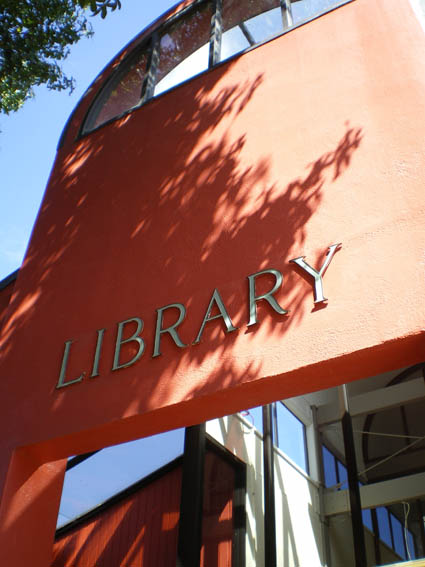
Waiting by the library door.
(Photo: Carol Bartlett.)
Mind where you walk when next you enter the Glen Eden library. It’s not that there’s a dog waiting at the door (it’s very well behaved); rather that what’s on the floor is worth noticing: a custom-made carpet whose patterns and colours represent the geological substrata beneath. The carpet follows on from the building’s internal wall, which has similarly subtle, beautiful earth tones.

Though spots comprise one of the patterns, there’s no leopard skin to be seen here. TV’s Outrageous Fortune series, made in and of west Auckland, may have bolstered the Westie* stereotype but it’s one this building seems designed to dispute. 


Architects Warren and Mahoney, whose string of awards includes several for libraries, worked with “lead artist” John Parker — the noted ceramicist and theatre-set designer from Oratia — to create the Glen Eden Public Library in 2004. Incorporating several permanent art installations, it went on to win the Built Environment category in the 2005 Creative Places Awards, presented by Creative New Zealand to recognise local authorities that have enhanced their communities through the arts. 

 Miles of aisles,
with magic carpet.
“Return to Eden”  
With the late, great Waitakere City being an avowed eco-city, this library was also a star in its council’s eco-firmament, and the cover story in a 2005 publication that the council co-produced. (Auckland Libraries appear not to possess ‘Sustainable Buildings in the Auckland Region’ but you may be able to find it online, through Google docs.) Under the heading “Return to Eden”, the building is described as:

incorporating passive ventilation and cooling systems, passive solar heating, optimised natural lighting, energy-efficient lighting and appliance systems, on-site stormwater management systems, timbers sourced from sustainably managed forest resources, and building materials selected for their longevity.

I’m not sure even the Almighty had things that well planned when he created the universe, but he did have just six days to work with (the seventh was for rest). And no doubt the extensive consultation required by the Waitakere City Council meant that the Glen Eden library took a bit longer. Did God “bring together a range of professionals and stakeholders” for his project? Probably not, as he made them — male and female — just before its completion. With necessity the mother of invention, he was forced to DIY. 

  
The Glen Eden Public Library, part of its community.
Down to Earth...
But let’s get back down to earth. It seems apt that this west Auckland public building makes a feature of the ground beneath our feet, as the geology of the area (the ocean included) is special. 


Come on!
Not only has it provided soil for Oratia’s orchards and Henderson’s vineyards; it also some time back, in the Miocene era, sprouted the Waitakere volcano — “similar in nature to our modern volcanoes of Ruapehu, Ngauruhoe and Tongariro”, according to geologist Bruce Hayward, but “five or six times the size of all three... combined” (A Field Guide to Auckland).

If few people think of that or of the architects’ “energy-efficient appliance systems” when they enter the building at 12–32 Glendale Road, it’s not the end of the world. There’s plenty more going on in this local library.

...and Down to Business
The catalogue and the book-issue machines are right by the door. Brilliant: borrowers can get straight down to business. There’s no confusing these with the Learning Centre computers, which are down the other end of the building.

The Learning Centre coordinator is trained to help with computer and internet use through classes or individual support. As with other libraries, computers are freely available, but at Glen Eden I noted that one is marked for ‘express’ use — a great idea when others are booked up.

That end of the library is shared with the children’s section (strangely deserted the day of my visit), and a wall-length window best viewed from outside, with sail-like shade cloths. Also outside is the six-metre-tall pou whenua carved from a single piece of kauri, by John Collins and Sunnah Thompson of Te Kawerau A Maki.


Pou whenua and flax by the library window.
Staff are visible, not just out in the library but in their office area too. This not closed off by such an out-moded thing as a door; instead there’s a wide, wall-high opening. Patrons appeared to respect the invisible boundary when I was in the library, though if I worked there, I wouldn’t keep any treasures on my desk.

Love Letters in Large Print
The Large Print section bookshelves, which a friend had urged me to check on, are the first you come to after entering the library, another good idea. Her dad Bert, an avid reader, struggles in some libraries’ Large Print sections — the aisles are too narrow to manoeuvre his walking frame — but at Glen Eden these books get a lengthy outside row, with plenty of space around them.

It’s the Thursday before ANZAC Day when I visit. Near the issue machines there’s a nod to the solemnity of the event (and consequently to Bert, a returned soldier), in the form of a book display. It may be the only such feature in this building right now, but as with a number of modern libraries, there’s space to display some books face out on the shelves where they naturally reside, and slanting top shelves are completely dedicated to face-out displays.


An Obama backlash?
Here at Glen Eden is something rarer: books ‘face out’ on the shelves look as if they’ve been selected rather than put there for convenience. Consider the Leaf, on garden foliage, deserves good marks for a clever title and attractive cover. A well-reviewed biography of Barack Obama, The Bridge, stands by Madam Lash, prompting conjecture about an Obama backlash. 

Another intriguing book that faces out is Four-Letter Word: New Love Letters, in which fiction writers ranging from Atwood to Le Guin to Zapruder (no, I don’t know who he is either) explore a classic form. If I’m surprised to see this in the large print section, it just shows that residents of Auckland’s west are not the only people subject to stereotyping.

A One-Time Drive-Through Village?
Glen Eden used to be a ‘drive through’ village. En route to Piha beach or the Dalmatian-owned orchards, where Mum would buy the best of the season’s apples and pears for stewing and bottling, we’d pass streets named “Fruitvale” and “Westward Ho”, whizzing through Glen Eden on the West Coast Road. It’s worth stopping and spending time there, however. 


Within walking distance
of the library.
As well as the library, there’s the enormous, historic Waikumete Cemetery, the subject of a small book written by poet Michael O’Leary while he was employed him by PEP.** Some stories in Gone West may be too good to be true, but it seems verifiable that with the railway and cemetery established, people assumed Waikomiti (as Glen Eden was then called) would thrive:

the Weekly News during 1886 said, “the rites, ceremonies and requirements of the cemetery will be sure to attract fresh residents to the township and so around the city of the dead will arise a new city of the living.” Unfortunately, while the not so fresh residents kept arriving, it was not until after the Great War that any sort of real population and commercial growth occurred.

The railway station built in 1880 still stands near its original site, though it’s been altered and currently houses a cafe — perhaps not such a different enterprise from the tearooms that were once the station’s neighbour, together with the local library and Buchanan’s stonemasons.

Last Stop in a Long Journey 
Glen Eden’s station is distinctive in having once been the very last stop for many Aucklanders. Funeral trains had coffin-bearing boxcars marked by white crosses and, according to O’Leary, mourners travelling in ordinary carriages. 


One of Glen Eden’s surprises: the Iglesia Ni Cristo (Church of Christ).
This Filipino denomination has two congregations in New Zealand.
Timespanner blogger Lisa Truttman writes that from November 13 of 1918, special trains conveyed some of the flu epidemic’s victims from Auckland to Waikumete, stopping first at Mount Eden for another contingent of both mourners and mourned. (Sometimes Waikumete’s dead were buried unmourned, but that’s another story.)

The stonemasons’ business and the tearooms may have benefited from Glen Eden’s industry of morbidity, but the library? Well, there’s nothing like having a good book to read during a long journey, though at some point in local history the library (rather than the train) moved on.


The Playhouse Theatre,
once the town hall and library.
Arts in the Community
Traces of another former library location can be seen at the Art Deco-style Glen Eden Playhouse Theatre. Built in 1935 as the local town hall, town board offices and library, it still has “PUBLIC LIBRARY” engraved above an external side door. You can peer through the ex-library window into what looks like a single room.

Today’s Glen Eden Public Library is directly across the road from the theatre, and on another corner opposite the library is a book exchange that appears to thrive, large, light and airy. This part of town bordering the Glen Mall shops is a small but perfectly formed arts precinct — with library patrons, in a way, also patrons of the arts. 


A mural on the book exchange wall.
* Westie: “often (derog.) a person from the (north-)western suburbs of Auckland, esp. perceived as being uncultured and uncouth [also attrib.]: westie chick).”
“westie n.” The New Zealand Oxford Dictionary. Tony Deverson. Oxford University Press 2004. Oxford Reference Online. Oxford University Press. Auckland City Library. 22 April 2011 <http://0-www.oxfordreference.com.www.elgar.govt.nz/views/ENTRY.html?subview=Main&entry=t186.e60708>

** PEP — “Project Employment Programme (a state-subsidised work scheme)”, according to The Oxford Dictionary of New Zealandisms, a new book that defines approximately 6500
Kiwi terms.

Friday, 15 April 2011

Beside the Big Mount Wellington

Ellerslie–Panmure Highway, Mt Wellington behind.
(Photo: Carol Bartlett)
Many have disappeared; others are dented or diminished, but Auckland’s volcanoes are very much part of our lives. Some, despite our best efforts, still dominate the landscape.

Mount Wellington, in whose lava field New Zealand’s largest aggregate quarry made its home and built a fortune, is one of the latter. The volcano still has its 100-metre-high cone, concealing an explosion crater 60 metres deep.

From Stud Farm to Shopping Mall
 
Local landmarks that are manmade include Moyes’ car yard, “beside the big Mount Wellington”, as John Moyes likes to tell us in his TV ads, and that flat-as-a-pancake expanse we drive around — the Panmure roundabout, which the transport planners are already plotting to replace.

And don’t forget Sylvia Park. Though now a shopping mall, it started as the stud farm belonging to the Messrs Morrin, who named it after a mare. In the Second World War, US and New Zealand forces turned the site into military food storehouses and workshops, still bearing the stud farm name.

There was even a “Sylvia Park Shopping Centre” before the one we know today. Initially it was “three shops... Armishaw’s dairy, Gatwood the butcher, and the Cumming’s brothers grocery”, according to RA Baker’s local history (
From Bush to Borough, 1987). “At this time in 1952, they were surrounded by cabbages belonging to the Chinese market gardeners and scattered residential sections”. By 1986 great progress had been made, with “the new Sylvia Park Maxi Mart adjoining the Woolworths Supermarket”, and McDonald’s — the hamburger joint, not the old man’s mythical farm.

The new Sylvia Park shopping centre is New Zealand’s largest; larger than any Westfield. (Those malls are presumably no relation to the Westfield Freezing Works that ran here in industrial south-east Auckland from 1908 to 1989, as Australia’s Westfield Group arrived in this country only in 1997.)

By design the centre pays homage to ‘heritage’ with cones, colours intended to suggest our most quarried volcanic rock and, among other things, a roof form mimicking the military warehouses that stood to attention for more than half a century, latterly in rather shabby uniforms. Thankfully it hasn’t gone so far as to replicate the conditions that made Mount Wellington “the worst hit smog area in the country” (wrote RA Baker), where in 1955 “hundreds of houses... were turning black overnight from the acrid industrial fumes”. 


Maungarei across Panmure Basin.
The Watchful Mountain  
In its present form Sylvia Park wins popularity contests in our City of Sales — I’ll wager more people promenade there than ascend Mount Wellington — but does it really shape and enlarge our landscape? I don’t think so. The volcano does that.

The Maori name for Mount Wellington is lyrical: Maungarei, meaning alternatively “the watchful mountain” or “the mountain of Reipae” — a Tainui ancestress who flew to Northland on a bird. But whatever you call this place, at 9000 years old it is the volcanic equivalent of a spring chicken. In Auckland, only iconic Rangitoto is younger (600? Pshaw! It’s a day-old chick, if that).

Just over a kilometre away is the Panmure Basin, a 28,000-year-old explosion crater marking another volcano... or two, it now seems: in 2008, scientists found what they believe is another volcanic cone buried there.


Panmure Basin: Still Waters Run Deep
The basin is well used by the community, and recreational organisations dot its shores (including the former Swimarama, where I had lessons as a child). The day we visited, people were running around it, sailing on it, fishing in it, admiring the views and the birdlife.
 
Fishing near the Tamaki River entry
to the Panmure Basin.
Its still waters carried no sign of current volcanic upheaval nor of the taniwha Moko-ika-hiku-waru, which used this crater as its eating vessel some centuries ago. But something must have been after the kahawai, Carol said, as the fish were jumping clear of the water.

A hop, skip and jump away from the basin is my favourite manmade Mount Wellington landmark, albeit one I nearly missed. When I looked up the Mount Wellington library, it no longer existed. It’s now the Panmure library, which makes sense, as it’s around the corner from Panmure’s main drag, Queens Road.

The library is a bit like the Panmure Basin, huge and full of interest, with still waters running deep. Even the approach is fascinating. Queens Road must originally have been just like any flat white shopping area but now offers delights as diverse as WHOLE PIGS (in a prominent possie at the corner), Luksha Kiwi Mart (For Your Taste and Quality Spices), Sonam’s Video (Home of Indian Entertainment), Sri Puteri’s Malaysian Mamak Flavours (Ice Kakang and Ice Cream), and Tres Marias — Three Marys? — Trading (Importers of Filipino Products).

As we strolled, we saw lots of cars parked in Queens Road but, strangely, few people. Two ardent men, laying hands on a third as they invoked the Lord Jesus, made the greatest impression.

A “spacious city library”
The library at Panmure must have dipped into the same paint pots as its sister at Point Chevalier — the colour scheme of coral, lime green and grey is identical. Both buildings were purpose-built and date back to the late 1980s, but Panmure’s coat of paint may be more recent, as it looks more vibrant, not worn at the elbows or frayed at the edges. 


Tongan books, there for the taking.


Panmure’s library is much larger than the Point Chev facility, whose scale probably befits a seaside suburb. If you view Panmure as ‘just another suburb’ that may seem strange, but this building was designed as the “spacious city library” (says the poster in the foyer) of the brand-new Tamaki City, which formed in 1987 from the amalgamated Mount Wellington and Otahuhu boroughs. It includes room for council activities: even today, the Tamaki–Maungakiekie Local Board meets in another part of the building.   

This library also seems more spacious than the current Manukau City Centre and Research libraries, which I presume have operated as the hub of the former Manukau City’s 16-library structure. What’s more, Tamaki City ran for just two years before Auckland (with its own city library) swallowed it up in the 1989 amalgamations. That’s okay, though, because a bigger fish came along and ate Auckland so now we’re all fins (and gills, scales, gut and tail, etc) together; all part of the same politically modified sea-creature. 

A place for play at Mount Wellington Library.
Becoming a Blended Family
The Auckland region’s public libraries have been becoming a blended family for a long time — since before the supercity took shape — but the various concentrations of resources must still do their managers’ heads in, especially considering that library buildings are less easily picked up, moved and plonked down than happened with Point Chev back in the 1920s.

The great thing is that all of us can use Panmure Public Library, or any other in Auckland, even without going there. It just happens that I had more fun crossing the city to call in than I would simply picking up a Panmure book from my Avondale branch. 

I’ve been trying not to have favourites, yet Panmure may be my best library visit so far. Nothing hangs heavy in this place. Nobody dominates. There’s plenty of thinking space, play and work space — even a “Quiet Reading Room”, which may sound old-fashioned, but it’s in use. The public noticeboards are extensive. 

It’s not all about the space, however. The great posters must come from some central marketing department of the libraries, as I’ve seen some elsewhere; otherwise the displays are APOW (all Panmure’s own work), with good use of colour and some well chosen books. One, complete with wheelbarrow, features the “King of the Mountain” event scheduled for Mount Wellington in May.

A display for Mount Wellington’s “King of
the Mountain” event. (Photo: Carol Bartlett)
The notices that booksellers call shelf-talkers reveal a keen sense of humour, with “Mini-Me” recommending short stories, “Gollum” fantasy and “Freddy Krueger” horror. Two weeks before the school holidays, there was already a poster announcing kids’ library activities for the duration. 

This place, I can see, is used by all sections of the community, which is not an affluent one. An Akozone Homework Centre operates here, and with library help some of its participants solved a local crime that they witnessed outside, late last year. 

Mount Wellington’s Mystery of the Aztec Deity
Of course, nobody’s perfect, and if I struggled it was in finding local stuff to borrow from this local library. The ‘local history’ section put in a plug for the Panmure Historical Society but most of its books were from around New Zealand and the heritage trail on the wall was Mount Albert’s, though Panmure pamphlets were also available. Mt Wellington: 100 Progressive Years, for which the online catalogue mysteriously lists the Aztec deity Quetzalcoatl as a subject, is only at the Central Auckland library (for reference only) and Takapuna (a lending copy).

It pays to ask. When I did, a man behind the desk was able to issue me an apparently “reference only” copy of another local book for a couple of days, and he offered more than once to order the first for me. When the only operational catalogue-dedicated computer was in use, he obligingly set Carol up with one at a librarian’s desk.

Ah, the public library: long may it mark the land and enlarge our minds — even as long as Maungarei, the watchful mountain.


One of the quiet corners of the library.


Monday, 4 April 2011

The Library and Lieutenant Chevalier

On Saturday I dived deep into the past of Point Chevalier. It’s taken a while for me to surface, but I’m beginning to know the place.

So I’ve heard the stone crusher at Meola Reef and the emergency siren at the Oakley Mental Hospital. I’ve eaten hot chips from the Glamuzinas’ fish shop, stained my fingers gathering blackberries from the paddocks, smelt the fennel growing wild, and come home filthy from the mudflats. I’ve danced at the beachside Dixieland Cabaret of the ’30s and bowled at Hallyburton Johnstone.  


The former Ambassador Cinema.
(No trams these days.)
I’ve been right there: catching the tram to Hall Corner, rolling jaffas down the Ambassador Cinema’s sloping floor, fishing for piper off Piper Rocks, fossicking at the tip, picnicking with the Watersiders at Coyle Park. And of course I’ve spent time at the library — all part of the Point.

“It began with a window”, writes Peter Wells of his own experience at the Point Chevalier library. “It was an old-fashioned sash window: two oblong panes looking up into the sky. I was lying on my back, on the floor. The librarian was reading. It was story hour.” He’s exploring one of those epiphanies we all have in childhood. His is about “the power of stories, the luminosity of written language... an aperture to another world”.

This is from Wells’s award-winning memoir, Long Loop Home. It seems a shame that although you can borrow it from Auckland Libraries, it’s not available — or at least not right now — at Point Chev, the place that’s a focus in its opening chapter (“The Point, and How I Got It”) and in many subsequent pages. 


The library entrance,
Great North Road.
Mind you, his library isn’t there either. I don’t mean that experience and perception are unique to the individual (though they are), but that he writes of the second Point Chevalier Public Library. Today it’s in its third incarnation. Or its fourth, if you count the foyer of the Ambassador Cinema, where the institution resided when the latest building was under construction in the mid-1980s.  

The library reincarnated  
The purpose-built ‘new’ library, on roughly the same street corner as numbers one and two (the corner itself has moved), counters the sobriety that public buildings used to manifest: dark coral and bright lime are shades the city fathers might be shocked to see separately, let alone together.

One feature I haven’t seen in other libraries is the conversation pit that’s obligatory in a retro home but that here— given local Lions Club sponsorship — should be called the Lions Pit. It boasts picturebooks and plenty of space for kids (or cubs) to sprawl, crawl and possibly growl. The colourful items suspended from the ceiling on one side are alternating Chinese lanterns and Polynesian lei, mixing the New Year celebrations of one culture with the recent Pasefika festivities of another. 


The Point Chev library’s Lions pit.
“Libraries love guys” display.
What of the earlier libraries? The first was a hand-me-down. It originally served as the Remuera Road Board office, then the Remuera library from 1915 to 1926. That year, Auckland city councillor Ellen Melville not only opened Remuera’s smart new public library but also re-opened part of its old library — relocated at the corner of Great North and Point Chevalier Roads. The appearance of this community resource followed petitioning by 400 Point residents.


Within 12 years, Point Chevalier outgrew the building just as Remuera had. It was delivered into the care of the Post Office, which issued stamps rather than bulky books, and the Coronation (George V) Hall next door became the library. That is Wells’s “old drill hall, with its tongue-in-groove porch, its protective veranda, its soaring roof”.

One book at a time
Others write about the library/hall and its predecessor, too: “I made a daily trip... as we were only allowed to borrow one book at a time”, says longtime resident Valerie Wood. (These days we’re allowed 35.) She is one of 60 people reminiscing in in Point Chevalier Memories: 1930’s–1950’s.

Though this 2009 collection is a local library initiative, it played hard to get when I went to borrow it: in the whole Auckland Libraries system, five lending copies were out on loan, five were for library use only, and one was missing. At Point Chev, not even a reference copy was on the shelf. I had to ask to see it, I gather because it tends to go AWOL. (It must be in hot demand for school projects.)

I spent hours reading it — it’s the source of the sensory perceptions in this post’s opening paragraphs, not to mention the news that some famous Kiwis spent their early days at this suburb, home now to millionaires’ mansions as well as state houses and bungalows. They included runners Peter Snell and Murray Halberg, cricketer Bert Sutcliffe, broadcaster Geoff Sinclair, his historian brother Keith, rogue politician John A Lee and bookwoman extraordinaire Dorothy Butler.

Inadvertently, I also found a book that was lost. The self-checking machine wouldn’t let me borrow A Building Known as Carrington. “It’s been reported missing,” said the librarian. “Thank you for finding it!” This backgrounder on the former mental hospital (variously Whau Lunatic Asylum, Auckland Mental Hospital, Oakley, Carrington) that’s now part of the polytechnic is a slip of a thing but one fact speaks volumes:


In the five years between 1952 and 1957, 500 door knobs were fitted. Patients now opened doors which had once been opened only by institutional keys. 

An early plan displayed at the
library. At centre right are
Meola and Motions creeks.
A book doesn’t have to be big to be informative. It doesn’t even have to be up to date. Thanks to Rangi-Mata-Rau: The Story of Pt. Chevalier. 1861–1961, borrowed from the Central Library’s basement, I know that “Target Street” (now home to the retirement complex Selwyn Village) is so named because the imperial troops had their rifle range there, supervised by a certain Lieutenant Chevalier — and that in the early 1860s the way to the beach, Point Chev Road, was Barracks Street. [Click on “comments” below for
Timespanner’s correction.]


The Point of no return
Here the author takes on a confiding tone, even a gossipy one: 


Just at this time, the beginning of the Waikato War, two strange Maoris appeared at the settlements and almost overnight the local Maoris disappeared, leaving their canoes on the beach, and several on Pollen’s Island. They never returned to the Point and the canoes were there many years later. One Maori known to the whites as Te Whare Bob, who had a deformed leg, was seen at the Gate Pa, Tauranga some years later. It is believed that they joined forces with the Waikato rebels.

In Rangi-Mata-Rau (from the Maori name for the beach) we also read that early in the twentieth century, the clifftop by the sea had a quarantine hospital — for the smallpox epidemic, among other things. There’s no word on how many entered or left, on foot or by stretcher, but the institution at the future Coyle Park didn’t last. Auckland Hospital Board had “never been favourably disposed” towards it “as it was in such close proximity to one of Auckland’s favourite beaches”.

The past is present in Point Chev, if we think about it. Caffe Ro, where Carol and I enjoyed lattes after our library visit, would have had sawdust on the floor and meat cleavers in frequent use during its former life as the Pt Chev Road butchery of Len Fearon. Opposite is the (re)tired iron archway announcing the Hallyburton Johnstone sports facilities, opened in 1927 after bowling enthusiasts agreed to pay the impressively named farmer an annual sum that would add up to their eventual ownership. The Point’s bowling and tennis clubs remain there today, with more modern signage.

Turning full circle
Some things turn full circle. Mr Kircher’s bike shop may have long gone but rode — “a haven for the more discerning cyclist”, according to one listing — now sells its shiny new contraptions on the corner where a furniture shop offering “draws” traded for years. In Point Chevalier Memories, senior citizens comment on the recent return of younger people and families to the suburb. “It is funny how things go in cycles”, Maureen Prouse says.


rode, across from the library.
 This blog has reached sign-off on Point Chev, but the place hasn’t finished with me yet. I’ll seek out Keith Sinclair’s anthologised ‘Ballad of Meola Creek’ and I’ve reserved his autobiography, Halfway round the Harbour. After much trial and some error I’ve also used my library membership to download ‘Point Chev Boys and the Landscapes of Suburban Memory’. This article, published in an international journal about geography, compares Sinclair’s childhood experience with that of Peter Wells. The differences seem remarkable.

As she nears the end of her 17-page exploration, the author Annabel Cooper writes, “Places are works of the emotions and the imagination.” So now you know (and I’m only half joking): the Point Chevalier that you’ve read about here is all made up. 


Further reading
Auckland Libraries’ Heritage Images Online (the earlier libraries are pictures 7-A11816 and 7-A11641);
‘Point Chev Boys and the Landscapes of Suburban Memory’, Gender, Place and Culture, 16:2, April 2009;
‘Point Chevalier: A Walk through Our History’ — pamphlet available from the local library;

Wednesday, 23 March 2011

Things I discovered at the Auckland Central Library

It’s not about books: it’s about the world.

Don’t be scared of bothering a librarian.

The question people ask is not necessarily the one they want answered.

It’s best to get the most authoritative source you can, and cite it.

A library is not the most convenient place in which to have a crush.

Hundred-year-old dust is darker and grittier than the newer kind.

‘No Ordinary Sun’, the poem by Hone Tuwhare.

Spy books come back smelling of cigarette smoke; occult books rarely return.

Libraries collect people of all kinds, and do not shelve them.

Beware the late-night cleaner in the third-floor cafeteria.

Not everything good is new or bought (sometimes it is old and borrowed).

A stink bomb set off in the lift will pong everywhere.

The library is where the plot thickens.

* * *

From the stacks at Auckland Central Library recently I requested Shirley Maddock’s Islands of the Gulf, which I’m reading as an extension of my research into this latitude of Auckland. First published in 1966, it’s something of a New Zealand classic, though it may have sat quietly in the basement storage for quite some time. The old “date due” slip pasted in the back above the barcode indicates that it was borrowed six times between 1982 and 1995, during the life of the library’s early Plessey issuing system.

Islands of the Gulf, a weighty book, is an enjoyable read with a ton of photos by Don Whyte. These are listed (as good books used to do with “tables of illustrations” or “plates”) over three pages just after the table of contents. 


What particularly struck me the moment I opened it was that just inside, after the endpapers with their map of the Hauraki Gulf, the book’s previous owner had written her name and the date:

Coral Ridling
Dec. 66.

Miss Ridling — her staff wouldn’t dream of calling her by her first name — headed the Social Sciences Department of the Central Library in the 1980s when I went to work there as a young student in my Christmas holidays (see ‘the best and worst library experience you’ve had’ in this interview, and its comments), so seeing her handwriting brought back memories. She taught me many things in my first job and was witty as well as efficient. To me she was very kind.
Several things I learned from her are above; the other items on the list all date back to that time.

Several libraries around New Zealand are led by Miss Ridling’s former staff, and looking online I found her described as a “respected mentor” who “always maintained that the day one did not learn something new in libraries was the day to look for new work”.


Miss Ridling gave Islands of the Gulf and years of service to the library, but she gave much more to lots of people. She lived in Grey Lynn, used the public libraries during her retirement, was active in the University of the Third Age, and died a few years ago.

Sunday, 13 March 2011

Give Me Land, Lots of Land

Leading his goat to glory:
a competitor at the 2011 Kumeu Show.
“The country is closer than you think”, said a billboard for this weekend’s Kumeu Show. It’s a catchy slogan, not meant for deep analysis, and sadly it’s only true in relation to the limits of urban sprawl: it doesn’t stand up when I think how long it takes to drive from my bungalow in the ’burbs to areas that appear untouched by a developer’s dreams or a town-planner’s schemes.

In the years I’ve headed northwest to Taupaki, Kumeu, Huapai, Riverhead and Waimauku — names from the map charting the way to Muriwai surf-beach — urban Auckland has expanded and the rural idyll has receded. Vineyards of the west have disappeared or started to straggle, and at the end of the Northwestern Motorway, Westgate has arrived. The latter may sound like Stargate and Watergate combined, but it claims to be “the thriving retail and entertainment hub of Auckland’s Northwest corridor... a statement in convenience, accessibility and variety”.


This weekend, my partner and I decided to go to the Kumeu Show. The organisers say this agricultural and horticultural event held annually in the late summer is the largest show in the southern hemisphere, and it’s been attracting townies like me for at least 40 years. (This I know, as my dad took me when I was a kid.)

There’s something special about checking out the chooks, admiring the axemen and noting the newest shearing techniques while eating hot chips out of a paper cup. And for those who want it, there’s all the fun of the fair: ye olde Ferris wheel, merry-go-round, haunted house, shooting gallery, Dodgems, and the open-mouthed clowns whose operator turns their heads.

There’s no need to promote the show to locals. They know it’s coming and presumably choose between clearing out, hunkering down at home, or entering some of the numerous competitions that A&H (or A&P) shows are known for: Adult Jams and Jellies, Novelty Animal from Vegetables and/or Fruit, or Giant Decorative Dahlias, to name but three on Kumeu’s schedule for “indoor exhibitors”.

I wanted, of course, to check out not only the chooks (etc) but also the local library and the locale. With Kumeu officially part of Auckland rather than Rodney District, as it was before November 2010, its public library is one of the 55-plus I can now borrow from — part of this latitude of libraries that I blog about.


A scare at the fun fair part of
Kumeu Show.
(Photo: Carol)
Giant marrows have their uses:
an indoor exhibit and winner.
Things became confusing on our Saturday morning drive when we reached the end of the motorway stretch of State Highway 16. Roadworks have gone on at that intersection for ages now, and every time I drive through (quarterly, at least), the lanes and directions seem radically different. But we made it through, still facing north-west.  

 Past George’s Strawberry Garden we went, past Soljans Estate Winery (whose carpark snared us during a prime-ministerial cavalcade a few years back), past... hang on: where did that massive roundabout come from? And that one? There they were, like crop circles placed by aliens in the night — except they’d arrived in the middle of the road rather than a paddock, and presumably exemplified increasing road use and urban sprawl rather than some inexplicable part of farming folklore.

We called in to the library before going to the show, as the former closes at 1pm on a Saturday and the latter goes on all day. The Kumeu Public Library is just past the place it’s named for; it’s at Huapai. I struggle to understand how two villages can keep their names while snuggling so close as to be on top of each other, but perhaps the local history I’ve since borrowed will explain.

 
Doug Armstrong, a local mayor and former TV presenter, opened the Main Road library and accompanying council offices in 1998 (the year Westgate came to be). It still seems brand spanking new, which is not to say it’s not well used: I get the feeling it is, though when we visitors from Avondale strolled in to the near-empty building just after it opened, the staff lamented that this was not a typical Saturday. Locals, they said, had called in during the week to avoid the show-related traffic jams.

A younger library user stands on his
own two feet.
(Photo: Carol)
 This library has a semi-circular design, with windows out to lush green grass. Inside, it’s as neat as a new pin. Around the curve are chairs, the practical but accommodating café type that’s designed to make you stay (and buy more coffee, or in this case browse more books). Displays are immaculate; everything looks carefully shelved; signs, notices and pamphlets are everywhere, but each is in its place. And oh, joy: the computerised catalogue is clearly identified. At many libraries, I find it hard to distinguish between computers for consulting the catalogue and those for general use of the internet, though of course there can be an overlap.

Some of the orderliness I saw at Kumeu may be common to all the former Rodney District’s seven libraries — this is the first I’ve visited — but I suspect somebody on staff has a very tidy mind. Perhaps it’s the friendly person who leapt to adjust the Pasifika display (an Auckland-wide library initiative, timed for the festival) before Carol photographed it to show her West Auckland school.


What did I expect to see at the Kumeu library? Farming stuff. Viticulture and the like. Muddy gumboots. They weren’t in evidence. Instead there was Pasifika, a display of books on how to “Get that job”, a crimescene-themed display of thrillers making good use of a desk (one of several individual workspaces tucked into an alcove, though in full view).


But why should an area that lives and dies with its boots on (be they gumboots or riding boots) have “farming country” stamped all over its library? People in Kumeu, its sibling villages and hamlets have enough of that without falling over it in a place they go to escape. Besides, the sort of books you might expect in a rural library are present, filed in the correct Dewey Decimal order.


Pasifika at Kumeu. (Photo: Carol)

Teen book covers displayed.
On the shelf at 636.5 I chanced upon a good wodge of books on keeping chickens, and the library catalogue has 17 such listings linked with the Kumeu branch. That’s more than you might expect in its suburban equivalent — though with chickens described as “the new black” at the Kumeu Show, Auckland’s EcoDay and even Facebook, this may be debatable. Are they the urban greenie’s chihuahua? Perish the thought! (That’s a quote whose source is in Oxford Reference Online, to which you can log-in using your library card.)   


As do other Auckland public libraries, Kumeu offers free computer and internet use, though in this case it’s courtesy of the Aotearoa People’s Network Kaharoa. The latter is is not some hippie/commie/separatist/peacenik outfit — God forbid, in the true-blue Prime Minister’s electorate — but a national and public libraries initiative to implement the government’s “Digital Strategy”.

I imagine Kumeu availed itself of APNK’s largesse before the district became part of “Auckland”, but the library staff clearly appreciate the increase in resources that the region’s single network of libraries has made available. The reference librarian, who came across as a great networker, talked of access to more collections of books (including Waitakere Libraries’ collections spanning 45 languages other than English), more reference databases, more everything. This, she and the others intimated, could only be good for local people.

We spent an hour at the library before making our way to the showgrounds. There we paid $15 apiece and a few bucks for refreshments to wander, experiencing sights, sounds, smells and tastes into the early afternoon. In the photos we took that day, the show stole the show — that’s what these things are for — but I enjoyed the Kumeu library just as much. I couldn’t help wishing it would tear up its Saturday timetable and stay open after 1pm: what I would have given to sink into one of those library chairs after all that walking about... 


Kumeu library: a place to rest
as well as read. (Photo: Carol)

For a recent rundown on Rodney District population and development, check out this story in the Rodney Times.