Saturday, 10 March 2012

Catching the Bus to WHY-car-whyyy

The Waikowhai bus is part of the fabric of Auckland, and those who rode it together as adolescents include Mark Greatbatch (cricketer), Russell Crowe (gladiator) and Simon Prast (Gloss-ster and theatrical type). But even though I’ve seen many buses bound for Waikowhai during my lifetime, until a few weeks ago I hadn’t a clue where it was.

The name is Wai meaning water, Kowhai as in the yellow-flowering tree. It’s long been said WHY-car-whyyy in our drawn-out New Zealand English, so when I heard it pronounced in the Maori way, I didn’t link it with the Waikowhai bus — or yet know where it was. Why-CORE-fi, said my physio, a Pakeha enunciating the Maori simply, beautifully, unselfconsciously: My husband is the principal at Waikowhai Intermediate.

Kowhai motif.
Outside the library.
Green Belt and Bible Belt
The renovated Mount Roskill Public Library boasts a new kowhai-flower motif and shiny green paint. Both are superficial and easy to slap on, but when I heard that they symbolised the nearby green belt extending to the Manukau Harbour, a light went on in my mind.

Wai-kowhai: it’s the place of the green belt, the bus, and my physio’s husband’s school. The suburb that hangs out with Lynfield, Three Kings, Hillsborough, Mount Roskill and somewhere called Wesley. Together they constitute what I’ll call Greater Mount Roskill, a borough from 1940 to the first big Auckland amalgamation of 1989.

Keith Hay’s Mt Roskill erection.
It's illuminated at night during
major Christian festivals.
I prefer the flexible fit of a green belt to the restrictions and strictures of a bible belt, but it’s as the latter that Mount Roskill has been best known. The influence of local housing magnates Keith Hay (Keith Hay Homes) and Bill Subritzky (Universal Homes) may have had something to do with that.

As mayor for 21 years, Hay had a gigantic cross erected on top of a volcano, distributed copies of the Ten Commandments to local schools and described churches as “the heart of the community”. (His son also became a Mount Roskill mayor before, as Auckland’s deputy mayor, opposing the city’s gay paraders and other habitués of the immoral demi-monde.) 


Subritzky, influential in church, business and local politics, gave a Bible to everyone who bought a Universal Home. In the borough’s penultimate year Mount Roskill had New Zealand’s highest number of churches per head.  

The demographics have changed over the years, and Mount Roskill is now home to people of diverse faiths, including many Muslims. But Hay’s cross still has its home on top of the extinct volcano.


Multicultural Mt Roskill (Stoddard Road).
Puketapapa
The Auckland Council has adopted this landmark’s Maori name, Puketapapa, for the diverse area that the local community board covers. Perhaps “Puketapapa” will eventually become as well known as Maungawhau (Mt Eden), Maungakiekie (One Tree Hill) and Owairaka (Mt Albert).

“Flat-topped hill”, its meaning in English, seems apt. The two shallow volcanic craters created thousands of years ago must have given the mound a flattish look, but since the early 1960s, when a water reservoir took the place of 25,000 cubic metres of scoria, it’s been flatter still.

People find various ways to explain the most widely used name for the volcano, “Mount Roskill”. One appealing idea, if only because it loops neatly through the “bible belt” identity, is that it commemorates the peripatetic nineteenth-century evangelist John Roskill, who held services there and later committed suicide. Perhaps most appealing to those mischievously inclined is “Mount Rascal”, briefly bestowed in the 1840s. A variation of that gets an airing in Toa Fraser’s wonderful 2006 film set in the area, No 2. 


Local volcanic rock features around the grounds of Three
Kings School, including in walls that relief workers
built during the Depression of the 1930s.
The Volcano Belt
From the top of Puketapapa/Mount Roskill you can see several other volcanic landmarks. The nearest — Great King or Big King, depending on who you read — is the sole survivor of the original “Three Kings”, a single volcano whose major cones were actually five in number, according to Volcanoes of Auckland. An early Maori name (for the survivor or the trio, again depending on who you read) is Te Tatua o Mataaho, referring to yet another belt or girdle: that of the volcano deity Mataaho. (He popped up previously in another post,
Mangere: Scratching the Surface.)

Commercial quarrying at Three Kings probably began in the 1910s and was quick to diminish the crowning glory of two — their cones. A local history, Not Just Passing Through, records that a local man was surprised one day in the 1920s “to see Mt Eden appear over the far side of what had previously been a vista of the Southern King”.

Thus continued the destruction of what Volcanoes of Auckland describes as “probably the most complex” volcano in the 50-strong Auckland field. Lava from the Three Kings eruptions nearly 30,000 years ago had flowed several kilometres, as far as Western Springs, and created “some of Auckland’s most accessible lava caves”. These remain (albeit on private land): tours of one called Stewarts Cave are a fixture on the University of Auckland’s continuing education programme.

As well as forming the dry-stone walls we’re accustomed to seeing around Three Kings, local scoria was once used less visibly in road-making. It was a key component of Winstone Aggregates’ “Roskill Stone”, a coloured building material, and is sold as a drainage material today. Winstone is still emptying the area, though the remaining cone is protected.

Looking for answers
at the Mt Roskill library.
A Complex Arrangement
The library complex that so vividly portrays Mount Roskill’s green belt also addresses its volcanic heritage, in orange and brown (fortunately some distance from the green). I say “complex” because this council-run building on Mount Albert Road is a bit like the Three Kings volcano, though it does remain intact.

It’s called the Fickling Centre, after another local mayor, and as well as the library it offers various community meeting rooms. My first encounter with the building was in a long-ago (and mercifully brief) incarnation as a recruit for Amway.


 Those who use it today range from music groups and service clubs to Secret Place Ministries, whose Pursuit Church pastors Ray and Pam encourage “intimate encounter with the Lord”, which “often includes times of ...soaking in His presence”. Perhaps worshippers leave their chastity belts and rings at the door?

Anyway, the building has undergone a $2 million refurbishment. This was probably needed, given that it was once unkindly described as “an anonymous block in a darkened corner of the downscale shopping centre that passes for the heart of Mt Roskill” (Alistair Bone, New Zealand Listener).


In the audience at the Fickling Centre
reopening ceremony.
About 90 people gathered for the council’s reopening ceremony and to hear the ubiquitous speeches — quite difficult when the steel-clad air conditioning along the length of the room contributed its thunderous roar. From across the lane, Club Physical’s blaring fervour also made its presence felt, like a hyped and miked Christian revival meeting. We were in Noise City.

I did hear the big boss of Auckland Libraries, Allison Dobbie, say that the refurbished library offers “quiet zones, which have become so important” (alluding no doubt to a recent hullabaloo arising at the St Heliers branch). When she pointed out the symbolism in the design, she meant the colour scheme and kowhai and not the aircon, but it was easy to drift into a reverie about just what the latter might symbolise.


 Something — the Fickling Centre as a whole? — is “a flexible, win-win model for everyone”. Perhaps that comment related to the Citizens Advice Bureau’s new location within the library, which seems to make the CAB people very happy. 

Advice and guidance,
in alphabetical order.
Their speech-giver told a tale I’ve since found in Not Just Passing Through, of the then mayor Dick Fickling turning up unannounced at a meeting about forming a CAB: “Turning off the lights mid-meeting, he regaled attendees with his opinion that when people were looking for advice and guidance, the family was the place to go for it.”  

Well, now the Mount Roskill library is the (or a) place to go for advice and guidance. That has probably been the case since long before the CAB moved in, perhaps from the library’s opening in 1977 — during Fickling’s mayoralty. And of course, the library can be with you always, even once you’ve left the building. “I sat home and read,” Roskill-raised writer Tze Ming Mok once said of her upbringing: “I sometimes say I was raised by the Mount Roskill Public Library.”

Mangere Mountain from Waikowhai Park.
My preferred Secret Place, Waikowhai,
on the Manukau Harbour.
Postscript: Arriving at Waikowhai
I did arrive at Waikowhai, eventually, though I went by car rather than bus. It’s one of Auckland’s hidden treasures, with extensive parkland going down to the sea. 


Where there are homes, you’d expect them to be mansions, given the million-dollar views. Most of them aren’t. The proximity of the rubbish tip and the Mangere sewage ponds put paid to that idea.

The
Waikowhai tip has disappeared now, there’s regenerating bush, and the sewage works have been replaced by a leaner operation which, rather than being meaner, is much more environmentally kind. You can gather shellfish again from the local shores, though according to Not Just Passing Through, leachate from the old tip continues to pollute Faulkner Bay.

Naturally, the area is rich. I look forward to learning more about the geology and the relatively recent fossils of Wesley Bay. And I want to know what’s so special about nearby Lynfield that Dr Willy Kuschel looked at beetles there for 15 years, producing a study that became world famous.  


The staff workroom has moved elsewhere to
create this open-plan public quiet zone in the library.
Library Facts and Figures
  • Within the old Auckland City’s 17-library system, Mount Roskill’s was the busiest branch — second only to the Central Library. In the 55-library system it still bustles more than many.
  • The recent library refurbishment has added 120 square metres, community rooms and unofficial quiet zones. The colour scheme is lighter and brighter. Window views previously sealed off from the public are now accessible to all.
  • The Mount Roskill library previously underwent extension in 1995 and major renovation in 2002.

Mt Roskill Public Library children’s section.
Interesting Reading
The major source for this post was Jade Reidy’s Not Just Passing Through: The Making of Mt Roskill. A book by Bruce Hayward et al, Volcanoes of Auckland: The Essential Guide, also helped.

Heartlands’ by Philip Matthews (New Zealand Listener, Feb 11, 2006) reviews No 2 and reflects on Mount Roskill’s “ethnic-melting-pot quality”, something this post has failed to do. Tze Ming Mok’s prize-winning essay ‘Race You There’ (Landfall 208, Nov 2004) does this too, as a starting point for her wider reflections on multiculturalism.

Historian Lisa Truttman’s recent Timespanner blog post ‘Wanderings at Three Kings’ offers observations on the Fickling Centre reopening, with photos, and other insights. At least one other post discusses the new Mt Roskill Historical Society.

Friday, 3 February 2012

On Being Seen and Heard (or not) at St Heliers

Browsing at St Heliers Public Library.
If we’re to believe the letters column of our daily newspaper in the last few days, reading is simply not possible in the St Heliers Public Library. It’s as much as any local resident can bear to dash in, pick a book (any book) and dash out again before the noise pollution on the premises offends their sensibilities, not to mention their ears. Many of the polluters are children, who insist on being heard as well as seen. 

The writers to the New Zealand Herald seem to yearn for the Good Old Days of public libraries. Back then, stern, fusty staff shushed everyone and the only sounds from patrons were those of pages turning (not of pins dropping, as the library was no place for sharp objects). 

Just imagine how they — letter-writers and/or the librarians of the G.O.D. — would have responded had they been at the Auckland Central Library a week ago when a performing duo, the Dresden Dolls, presented their “ninja gig”: at that event the punk cabaret artists succeeded in persuading some 300 people in the audience to chant “F– it” in unison.

The Butchers, the Bakers...
Ah, the Good Old Days. St Heliers must have been a quieter place in the late nineteenth and early twentieth centuries. Groups of Auckland citizenry including butchers and bakers (sadly no candlestick makers, though there was at least one temperance group) would catch the ferry there for picnics and other excursions, walking the quarter-mile down the wharf to get to the beach. Tamaki Drive did not exist, though there was a Tamaki Road Board, the local (very local) equivalent of today’s Auckland Council.

This outlying area had a library but it wasn’t especially public. In the absence of a suitable building, its books were in the custody of the local fire brigade, in premises where the present St Heliers library stands. Apparently the firemen enjoyed reading the books, which local residents had donated and the board had supplemented. But peace and quiet? Not likely, given the clanging of bells and everything else that accompanies emergencies of an incendiary nature. 

The St Heliers Public Library building was initially
the seat of local government, and its lamps
bear the initials of the Tamaki Road Board.
Today’s library was built in 1926 to a design by Grierson, Aimer and Draffin (better known as the architects of the Auckland War Memorial Museum). This brick building was the road board headquarters the initials on the lamps out the front offer a clue to that  — as well as home to the fire brigade. It was fully converted to its present use in 1931 when St Heliers became part of Auckland.

The amalgamation may not have had an entirely positive influence on the area; even in the G.O.D., Auckland’s own central city library wasn’t always quiet, as an 1890 letter to the Auckland Star attested. “A Ratepayer” noted that “the noise of the draughts players in the reading-room is very annoying, and I would suggest a separate room, or that they should be entirely done away with.”

Has it occurred to anyone that if there’s a problem with libraries, it may be space rather than noise? Even in its the 1940s, according to Wynne Colgan in The Governor’s Gift, users of the St Heliers branch sometimes had to queue in the street just to get inside. Over the decades it has undergone several extensions including, most recently, an ingenious and all-but-invisible one that moves the essential “back office” upstairs. However, this suburban library is still small. I doubt there’s enough space to add a “quiet room” like those I’ve seen at the Mt Wellington and Botany Downs public libraries. It’s also very busy, with a thousand or so visitors a day. 

Xena, as portrayed by Bunny Elwell
at the St Heliers Public Library.
Xena the Library Cat
One such visitor, a senior citizen, seems unfazed by it all, and perhaps some of today’s complaining ratepayers could take a leaf out of her book. Xena the library cat has a home of her own but gets lonely when her human indulges in a bad habit of going to work. So this beautiful tortoiseshell, who is 15 now (a septuagenarian, in human terms), strolls two kilometres down to the library every day. She has also been known to call in at the nearby fish and chip shop.

Xena is popular with locals and has become a focus for the branch, with her portrait by staff member Bunny Elwell now on the wall. The St Heliers Public Library has held a contest for children to paint their own portraits of her, has run Facebook classes for senior citizens using Xena’s own Facebook page as a learning tool and, late last year, presented her with a rug made from squares knitted at library knit-in events.

YouTube shows this cool cat waiting outside the library and she even has her own Twitter account, where her profile reads: “You can usually find me lounging around in the Large Print area of St Heliers Library in Auckland. My interests are eating, sleeping and extreme road crossing.”

“Summer Reading
Adventure” notice.
Xena wasn’t in attendance the afternoon I visited this library. In fact, the place was pretty quiet — just how some people like it. There was evidence of children in the form of a half-eaten lollipop on the step, a pink scooter propped against the wall (near the “no bicycles” sign), and a noticeboard promoting the Auckland Libraries’ “Summer Reading Adventure”, but otherwise the juvenile form of Homo sapiens was little seen, and certainly not heard.

The computers, unusually for most libraries I’ve visited, had no child users at all that Sunday afternoon. Nobody spoke loudly on their cellphone, another complaint of the “shush” brigade, and one with which I can sympathise — though I don’t think it’s especially a library problem. I saw for myself, too, that several adults were reading books without difficulty. Good on them.

Adults seen reading in the
St Heliers Public Library.

Sources
See the links in the post above, also:


St Heliers Bay peace and quiet.

Thursday, 26 January 2012

Elsewhere, Anywhere and Right Here: The Many Locations of a Public Library


Eaton’s catalogue, possibly not where libraries
source their supplies. This is at
the heritage
room, downtown Edmonton Public Library.
Public libraries open doors to Elsewhere yet, in a way, many libraries could almost be Anywhere. Perhaps they furnish themselves from the same global sales catalogue, right down to their human fixtures, such as the habitual sleepers, the old guys who read the newspapers, and the tourists.

Members of this last group are found at downtown libraries, which perhaps they enter with eyes only for the internet. Tourists are not at the library to see landmarks or cultural artifacts, the stuff they’d do at museums and galleries: they generally wish to sit in comfort and quiet, if never very Far From the Madding Crowd, and attend to email, Facebook or YouTube, making themselves at home. Ironically, in so doing, they contribute further to downtown libraries’ ambience of both Elsewhere (exotica!) and Anywhere (universality). 

A Long Way from Anywhere
A long way from Anywhere and twice as far from Elsewhere is another location that a public library is concerned with: Right Here. Yes, a good public library tells us about the place it’s in, as well as the places it’s not — but to hear and see this, we may need to linger and poke about a bit. 

It’s not always as immediate and obvious as the English–Maori signs we have in some Auckland public libraries. It took me quite some digging to discover, for instance, that custom-made floor coverings in our Glen Eden and Massey branches represent their areas in artistic ways.

Sometimes, though, it’s easier to notice what’s “local” in a library when you’re new to the country, a complete stranger rather than a slightly straying citizen. In Canada late last year, I had the opportunity to be that stranger. 

On Being a Stranger in Someone Elses Country
In the month I visited, I managed to learn about the place not just by walking the streets and taking public transport but also by using public libraries — with help, as friends showed me around and borrowed books that I went on to read. Thanks to Canadian libraries and my local guides, I:  

Light Lifting is available at Auckland Libraries,
as is the Canadian Railroad Trilogy picturebook.
...  Joined in a bookclub discussion at Woodcroft branch library, Edmonton, that inspired me to read Light Lifting, the wonderful first book of stories by Alexander MacLeod. (Note to self: must also read his famous father Alistair, eg No Great Mischief.)
 

...  Listened to Gordon Lightfoot’s iconic folksong, Canadian Railroad Trilogy, while looking at the thoughtful, multi-layered illustrations in the picturebook by artist Ian Wallace. (If you borrow this, be sure to read the Illustrator’s Notes tucked away at the back.)
 

...  Got lost in but enthralled by RED whose author and artist, Michael Nicoll Yahgulanaas, is described as “the father of Haida Manga”. I know little of either Haida, an Indian tribe from the Pacific Coast of Canada, or Manga, the Japanese comic-book genre, so perhaps my quaint lostness is not surprising. Now I want to know more of both. (Does Aotearoa/New Zealand have Maori Manga? I am yet to find out.) Two other books by Yahgulanaas are in Auckland Libraries.

A little bit of Rome at Library Square, Vancouver.
(So is this library a round peg in a square hole?)
...  Took away a treasure trove of reading lists and research pointers from the downtown Vancouver Public Library. On the outside, this facility bears an unmistakable resemblance to the Colosseum in Rome — now what does that say about libraries opening doors to Elsewhere? Inside, however, the many resources include VPL brochures on such local topics as the fur trade, Chinese–Canadian history, fiction from British Columbia, First Nations traditions, hiking trails, and a self-guided tour of the library itself. (You can even get married there!)

...  Discovered, thanks to the downtown Edmonton Public Library’s heritage room, the importance of the Eaton’s catalogue, porcupine quill decoration and jars or bottles in Canadian life. This makes me wonder just what might catch the eye of New Zealand newcomers who browse the heritage collections of Auckland’s four central libraries — Manukau Central, Auckland Central, Waitakere Central and Takapuna.

Books from the heritage room,
downtown Edmonton Public Library.
Becoming an Armchair Traveller
My quest to know more about the big country north of the 49th parallel continued as I travelled back south and settled into antipodean life again. On the plane I read publishing impresario Doug Gibson’s Stories about Storytellers, a fascinating new memoir of his career extracting books from such famous Canadians as Pierre Trudeau and Alice Munro. I’m glad I bought a copy when I heard him speak at Edmonton’s LitFest (celebrating non-fiction), as Auckland Libraries doesn’t have it yet. 

In its capacity as doorperson to Elsewhere, I think Auckland Libraries has otherwise been faithful in carrying out its responsibilities to Canadian lit and learning. Back home I reserved and have since read Half-Blood Blues, Ghanaian Calgarian Esi Edugyan’s second novel. I’d heard her at the Vancouver International Writers and Readers Festival where, despite what I took to be her Canadian quietness, she really impressed. The novel, which secured a Booker shortlisting and won Canada’s coveted Giller Prize, is about an elderly black musician looking back at his days in the jazz age. (I thoroughly enjoyed it. If you get the Serpent’s Tail edition, don’t read the back-cover blurb or the teaser on the front: they tell a little too much.)

A page out of Emily’s book, Growing
Pains
, shows her humorous Self-Portrait
with Friends
. This copy
’s first home was
Leys Institute Library, Ponsonby.
Courtesy of Auckland Libraries again, I’ve pursued an interest born in Vancouver where I discovered the Canadian artist Emily Carr (though I wasn’t the first). This contemporary of our own Frances Hodgkins persevered, like Hodgkins, in adverse circumstances, and became a national icon — posthumously (which is too often the way).

Emily’s in the Basement
Carr is known for her story-telling as well as her painting, and among numerous buried treasures in the Auckland Central Library’s basement is a first edition (1946) of her autobiography, Growing Pains. This volume is in remarkable shape given its 60-plus years of knocking around public libraries, and it is a beautiful thing. I recommend taking a look once you know a bit about Carr. Though the writing is dated, it is very readable and its author has, unsurprisingly, a good eye for the colours and textures of language.

Her struggles to be accepted as an artist in her home country, and as a woman alone, seem to mirror those of Hodgkins. Carr also studied under Hodgkins in Concarneau, France — though sadly the autobiography doesn’t name this “fine water colourist”, whom she describes as Australian! 


Public library entrance
sign in St Paul, a small
town in Alberta’s prairies.
Clearly, my Canadian Studies can continue, with Auckland Libraries assisting. Porcupines, old barns, the dinosaurs of Drumheller... these are part of the Canadiana clamouring for my attention, and my presence Elsewhere seems to place no great limitation on distance learning.

It’s the middle of winter now in the north, however, so I’m particularly pleased to say the next stop in my Latitude of Libraries tour is Right Here at home, in St Heliers. Summer at a library by the sea — who could ask for more?

Monday, 26 December 2011

Hard Bittern: A Tale of Manurewa

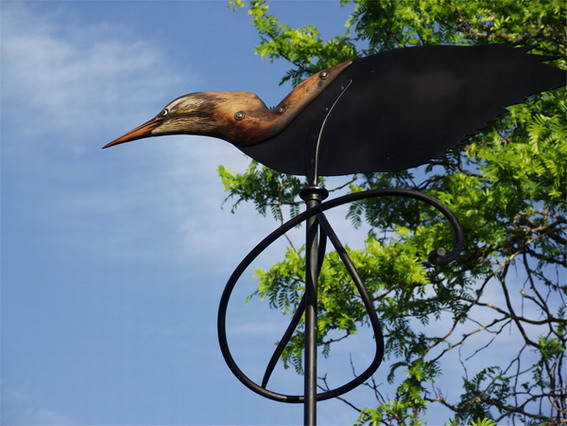
Bing Dawe’s Australasian bittern weathervane, shown at Auckland
Botanic Gardens in Manurewa,is part of his Watching out for
St Francis
series at the Sculpture in the Gardens exhibition.

Photo courtesy of Jane Sanders, ART Agent.
Manurewa means “soaring bird” to people whose appreciation of Maori language involves translating it into English. To others it means “drifting kite”. Birds and kites both feature in old stories about this part of South Auckland.

In the 1930s a Pakeha ethnographer and collector, George Graham, recounted “Nga Matukurua — The Two Bitterns” before an audience at the Auckland Museum’s Anthropological Section. This “Tale of Manurewa” was about twin pre-European pa, fortified villages on two neighbouring volcanic mounds. 


During Pakeha settlement these became known as McLaughlin’s and Wiri mountains but now they are known hardly at all, as my kind has spent decades erasing them. McLaughlin’s, about 10km from the Manurewa town centre, strikes me as a misplaced Mayan construction covered in grass, though in an Auckland Libraries anthology, poet Tony Beyer sees it as a temple from ancient Mesopotamia:

mclaughlin’s gashed hill
tiered into a ziggurat
by quarryings


Scoria from Wiri Mountain made railway ballast “all the way south to Ohakune”, according to Volcanoes of Auckland. This one-time landmark has kept only its lower northern slopes, incorporating “the best lava cave in New Zealand” plus, where a 60-metre-high scoria cone once stood, “a large lake-filled hole”. The authors have low expectations of its future, predicting it will be “flattened and earmarked for industrial subdivision”.

The Vigilant and the Careless
But let’s get back to the bitterns Graham mentioned. The Te Wai o Hua people’s hill-fort commanders in the late seventeenth century were dubbed Te Matukutureia and Te Matukutururu, respectively the vigilant bittern and the careless one. The careless bittern lost his head and consequently his life when Ngati Whatua warriors captured his pa — his fault, as when war threatened he had gone fishing for eels and fallen asleep (the local equivalent of fiddling while Rome burns). His kinsman on the other hill kept “his sentries ever posted, his pa entrance ways securely closed”, saving his village, his people and “his tatooed head”.

The chiefs’ avian identities settled on the hills: McLaughlin’s Mountain is more eloquently Matukutureia, and its careless neighbour Matukutururu. (That’s according to Manukau’s Journey, an Auckland Libraries e-resource, but some people apply these names the other way around.) 

At the botanic gardens, Manurewa.
These days The Field Guide to the Birds of New Zealand describes the Australasian bittern as a “Protected rare native... Usually solitary and stealthy”. Its favourite hideout is a swamp (or wetland, as we call these shrinking habitats now), but the matuku does fly. The noted artist and ornithologist Don Binney painted one soaring through the sky at Te Henga, West Auckland. In Manurewa, the popular Auckland Botanic Gardens currently feature Bing Dawe’s flying bittern at their Sculpture in the Gardens exhibition, on until February.

An Appropriate Emblem?
Could the bittern be an appropriate emblem for Manurewa today? It’s a suspicious bird (says William Herbert Guthrie-Smith in Bird Life on Island and Shore), and has reason to be: it’s embattled. So is Manurewa, if media portrayals are accurate — a suburb full of streets named Struggle, inhabited by Kiwi battlers.* Stories that have made the news and elicited wider comment are about the murder of a liquor store owner, attacks in bars, the Manurewa Cosmopolitan Club’s refusal to admit a turban-wearing Sikh man, residents’ opposition to a planned prison for men next to the existing women’s facility, concern about state house tenants “let in” to Manurewa, and a suspected drunk driver whose car critically injured two girls on the footpath. 


Doug Ford’s Manurewa murals include this tongue-in-cheek
(he says) portrayal of the fictitious Oh My God Fruitery.
When Manurewa lost South Auckland’s central business district to another ward last year, a councillor said the change “ripped the economic heart of the Manurewa ward”. The Auckland Council’s Manurewa board suggests in its just-published plan that the pre-amalgamation council “failed to show [the] urgency necessary to transform the Manurewa town centre”, a smaller set of shops and services than those in the central business district nearby. 

Earlier in the year, it was high noon in Manurewa for six whole weeks, with both hands of the town clock stopped on 12.  Auckland bureaucrats were held responsible for time standing still.

But the local business association has worked to spruce things up, commissioning mural artist Doug Ford to paint the town. Manurewa is also a semi-finalist for the 2012 national “Community of the Year” Award.

There have been moments of glory, several of them thanks to a man who is now a stern-looking businessman with spectacles and silvering hair. John Walker, a member of the Manurewa Harriers Club in his teens, started running seriously in the early 1970s and didn’t stop until he had completed 135 sub-four-minute miles, 20 years later. Sir John Walker represents Manurewa–Papakura on the council and chairs his Find Your Field of Dreams Foundation, helping South Auckland youth through sport.

Local MP and Prime Minister Bill Massey
unveiled the Manurewa war memorial in 1921.
Other Manurewa moments, commemorated rather than celebrated, came in wars fought elsewhere. An obelisk on the corner of Hill and Great South roads lists First World War fields of battle and locals who died there. This 1921 monument just outside the gates of Manurewa Central School, supplemented by more recent plaques, is reminiscent of war memorials in small towns all over New Zealand.

A Microcosm of the Community
The public library, 30 years old in 2012, is across the road on land that local historian Gwen Wichman says was once the school horse paddock. When we arrived on a Saturday morning, a Chinese woman and her grandchildren were just leaving with a fresh supply of books. We found many more children and teenagers inside, mirroring perhaps the high proportion of young people in Manurewa’s population (29 per cent are younger than 15 years, compared with 22 per cent Auckland-wide).


In one library nook, a pair of jandalled teens at either side of a small table flirted in a manner recognisable from a distance and probably across the millennia, pretending attention to their respective magazine selections while rather more interested in each other. At the far wall, a couple of pony-tailed girls watched over the shoulder of a classmate/brother/boyfriend as he watched something riveting on a computer screen.


Boy and book, Manurewa Public Library
Children of assorted ages engaged in activities communal and solitary at another table. By the bookshelves a small girl clad confidently in fuchsia colours of magenta and pink tried to converse with her browsing father (she’d already chosen her reading). A sneakered boy, cross-legged on the floor, was absorbed in the ROAARR! of the picturebook before him.

All these people seemed to reflect the ethnic diversity of the Manurewa board area, where Maori
and Pacific residents are 57 per cent of the population, and Asian people 15 per cent. The library caters for its community with Hindi and Punjabi collections as well as substantial Maori and Pasefika sections.

The low-roofed library building has a warm, woody atmosphere inside, thanks to sloping ceiling beams, brightly coloured signs and a vibrant mural by Kaiaua artist Tony Johnston. None of South Auckland’s “troubles” was evident when we were there; nor did anything appear to warrant the two — no, three — security officers we saw. They were sociable as well as vigilant, however. 

Above and below: Manurewa Public Library, outside and in.
 I chose two children’s books, Jan Mark’s Museum Book and Keri Smith’s How to Be an Explorer of the World, which I’ve wanted to read ever since it featured in Auckland Libraries’ Top 5 Goodies blog. Carol’s haul included a huge volume featuring photos by Annie Leibovitz. She also indulged her love of English poetry that has regular rhythm and end-of-line rhyme.

The Drifting Kite
However, I wanted to know more about the “drifting kite” of Manurewa. Though the library’s copy of Tamaki-Makaurau: Myths and Legends of Auckland Landmarks doesn’t include that story, the Auckland Museum Library and the South Auckland Research Centre (at Manukau Public Library) both have something that does, George Graham’s “Two Bitterns” lecture.

As well as explaining the Matukurua villages’ names, Graham told of a rivalry there between the brothers Tamapahore and Tamapahure. When Tamapahore’s kite flew better than Tamapahure’s, an incantation by the latter caused Tamapahore’s kite to drift away “to the far off Hauraki horizon”, its owner in pursuit. Manurewa’s full name is therefore “Te Manu-rewa-o-Tamapahore” — the drifted-away kite of Tamapahore.

So is Manurewa soaring bird or drifting kite? The local marae and schools seem to favour the latter but I get the feeling many Pakeha (not Graham) prefer the former. The soaring bird suggests a near-empty landscape, with nothing between us and nature; the kite indicates that people have lived and travelled around the area since long before the Pakeha arrived. 


Manurewa library activities communal and solitary,
literary and otherwise.


The Oxford English Dictionary, available online for Auckland Libraries members, describes a “battler” as “a swagman” and “a word used in Australia and New Zealand in various other shades of meaning... esp. a person struggling against odds.”

The opening lines from Tony Beyer’s poem Matukutururu are copyright and quoted here with his permission. The poem previously appeared in his collection The Century (HeadworX, 1998).

Manurewa population statistics in this post come from the local board plan. 

A typed transcript of the George Graham lecture is at Auckland Museum Library, with a copy at the South Auckland Research Centre.

Another source for this post was Manukau’s Journey, the Auckland Libraries timeline of South Auckland history researched and published by the South Auckland Research Centre, now at Manukau Library.


Sunday, 11 December 2011

The Reader, the Library and the Lens

Man reading, Vancouver Public Library downtown,
October 2011.
The man in this picture: what’s his story?

Of various photographs I’ve taken that show people reading in libraries, this one draws my attention the most. The man in the picture is not the first ever to be absorbed in a book. But his hands are almost clasped (in supplication, stress?), and the title of the book that tops the small selection next to him, Mass Destruction, is striking. The photo has him close up — although he’s half around a corner, facing away, there’s a sense of intimacy.

A public library is a public place. Photographic design (angle, distance) or accident (blurring) means few people are positively identifiable. And being seen reading or in almost any other library activity is not incriminating, nor anything to be ashamed of. So I keep using the camera. 

There is an ethical question, however: if people don’t know they’re being photographed or consent to it, am I crossing a boundary, taking something more than just a photo? (I’m not the only person who wrestles with ethical issues in this setting. The history of public libraries is full of books whose presence on the shelves has been challenged by outraged citizens or staff, and full of debates over intellectual freedom and privacy — particularly since the USA Patriot Act.)

A comment by the New Zealand writer Fiona Farrell makes me think that even the observed reader maintains his privacy, has a room of (and on) his own. “It is always so difficult to tell what is going on in a reader’s mind,” she writes in The Broken Book. “...The reader could at one remove be experiencing the thrill of illicit passion or considering bloody rebellion. No wonder the dictators and leaders of cults burn books and issue their edicts of forbidden texts.”

Carol reading, East Coast
Bays Public Library, Auckland.
Some things my lens doesn’t penetrate. I’ll never know the story, the one belonging to the young man at the Vancouver downtown library that day. I’ll never know what he’s reading or get inside his head; neither will anyone else who looks at that picture. And that’s the way it should be.

* * *

Farrell’s Broken Book set out to be prose about walking — it was to be this New Zealand author’s first work of non-fiction — but after the Canterbury earth quaked, the writing went in other directions as well: across shaky ground and into poetry. This is no great surprise for those of us who read her; it is a pleasure. I think many people like the way her writing refuses to confine itself. Very recently my bookclub loved this new book, and it features on all the “best of the year” lists I’ve seen so far.

During one section, “A Walk to the Botanic Gardens” (in the Oamaru of her childhood, perhaps?), Farrell finds herself in the Cork City Library, Ireland. There she talks of being “supposed to be writing a novel” but becoming distracted by old Irish texts, among which she discovers the old woman of Beare. (Thereby hangs a tale. That senior citizen is not one of the more bedraggled, down-and-out library patrons; she’s the narrator in a long and very old poem.) I especially like what Farrell then says about the library at Cork —

The reading room is filled with the sort of people you find in reading rooms everywhere: in winter, the old guys who sit on the streets in summer come in to read the papers out of the chill wind. There are school kids doing their projects and giggling surreptitiously behind the shelving. There are the natives of a dozen different countries dealing with officialdom on the library computers.
Above: newspaper stand, Edmonton Public Library downtown.
Below, two
photos of browsers, Vancouver Public Library downtown.
Yes, that’s a picture you could paint from a library in Auckland, New Zealand, too. And during October when I was in Canada, it was similar. At the Edmonton Public Library downtown branch, I smiled to see old codgers reading the paper just as the old codgers do in the libraries of my latitude. I wouldn’t like to suggest that the men in my photo had come in from the cold — it was only autumn after all, with temperatures not yet in the minuses — but I understand that this EPL branch and indoor shopping centres downtown are great places of refuge when winter gets really miserable, such as more than twenty below. 
 
Finally, I love Farrell’s comment about being a library browser: “I was there in the warm, browsing the shelves. I like that word, ‘browsing’. Like a cow picking its way from one delicious clump of clover to another. It’s a drifty word, full of purposeless pleasure.”

Yes, yes. (I’ve got the photos to prove it.) Thank you, Fiona Farrell, for putting all this into words.

The Broken Book by Fiona Farrell is published by Auckland University Press, 2011. It is copyright, and quoted here with permission. The photos in this post are the blogger’s own.
  

Glen Eden Public Library, Auckland.

Parent and child in pink gumboots, Massey Public Library, Auckland.
Shoes off, feet up, Edmonton downtown library.